Richard Mortensen's lectures
Introduction
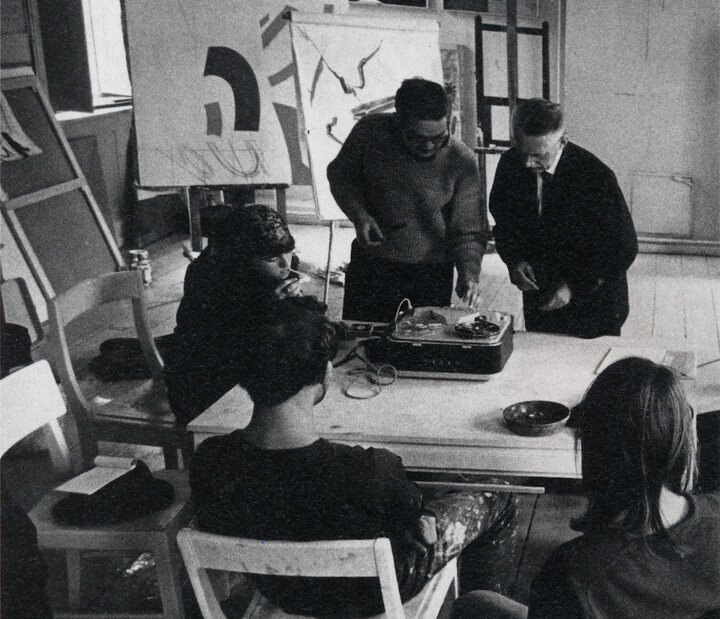
Richard Mortensen and his pupils during a lecture at the Academy of Fine Arts in Copenhagen. Photograph: E. Christensen.
The professor with the tape recorder
From the beginning of his tenure as professor, in 1964, Mortensen routinely taped his own lectures. Over the years, he also taped guest lectures, get-togethers with students and visits to exhibitions. The tapes provided documentation for the benefit of any students who had to miss a lecture due to work, illness or other reasons; they could catch up by listening to the tapes. If Mortensen was absent due to illness, he would also record lectures to send to his class.
He was aware that the practice was unusual, but it seemed to work for him, even if the students were not always thrilled to be recorded. In a recording from 1978, he says that he was widely ridiculed for his practice, both internally at the Academy and outside it, and that over time, he became known as ‘the professor with the tape recorder’.
The fact that many of these recordings have been preserved and now digitized provides an extraordinary window into Mortensen’s way of approaching his professorial duties. The recordings reflect his view of art and art education as well as his opinions on issues in contemporary society. He often draws on his personal experiences in the art world and shares anecdotes about artists he has met and from his life as an artist.
Mortensen had a broad international outlook on contemporary art and a clear awareness of the significance of historical art for a continued artistic practice. In his teaching, he sought to pass both on to his students. He took his classes to visit exhibitions and on study tours, including several trips to Venice with varying groups of students. From the tapes, we know that he encouraged his students to exhibit while they were still at the academy, and on several occasions, he took part in joint exhibitions with some of them.
We don’t hear much about internal conditions at the academy. Mortensen found the physical setting of the Charlottenborg building hopelessly outdated and frequently advocated for the establishment of an academy for visual arts in a modern, factory-like building, perhaps outside Copenhagen. He was not particularly interested in serving on the governing bodies, although he had some obligation to attend academy council meetings and the like. On the other hand, he was in many ways supportive of the students’ call for influence and access to resources, for example to found an academy magazine.
Recurring themes
By the time Mortensen began his teaching career, he had already positioned himself as an internationally acknowledged artist. During the 1930s, he had played a role in shaping the development of abstract surrealist art in Denmark. He organized exhibitions of international surrealist art and was part of a new, dynamic art scene. He was politically engaged and active in the Resistance during World War II. In 1947, he and Robert Jacobsen went to Paris, where they stayed at the artist house in Suresnes and were affiliated with Galerie Denise René. Here, Mortensen became part of an international network of artists and took part in the development of constructive art movement. He was active, engaged and received acclaim for his work, and during the 1950s he had his international breakthrough with exhibitions at the Venice Biennale and Documenta II in Kassel. Over time, however, Mortensen saw the atmosphere in Paris change. With scepticism and sadness, he saw how art was commercialized ‘Americanized’, as he put it – which was a key reason for his decision to return to Denmark in 1964. Later that year, he was appointed a professor at the Royal Danish Academy of Fine Art and settled far outside the city, in the rural town of Ejby near Holbæk. Subsequently, he began to take on large decorative projects, a new development in his practice.
Some topics outweigh others in his teaching, but Mortensen always seeks to include his own experiences with art and art environments. This gives us special insight into an important period in art history.
He often talks about experiences in his youth, during the 1930s, when Linien was founded, including his collaboration with Ejler Bille, Sonja Ferlov Mancoba, Hans Øllgaard and Asger Jorn, among others. Common topics include surrealism, surrealist experiments, ‘cadavres exquis’, his trip to Paris in 1937 and his encounter with the artists there, the launch of the Linien journal and his break with Vilhelm Bjerke Petersen. He also shares his views on Sigurd Næsgaard’s psychoanalysis, which influenced many other Danish artists during the 1930s.
His encounter with the art scene in postwar Paris is another recurring topic. His main focus in this regard is Galerie Denise René, whose development towards constructive art owed much to Mortensen’s involvement. His descriptions of the art scene are peppered with anecdotes about other artists, including Yves Klein, Serge Poliakoff, Victor Vasarely and Robert Jacobsen, among others. Mortensen speaks about critics, gallery owners, authors and others in the network and about everyday life in Paris, including visits to bars, cafés, exhibitions and other artists’ studios. His stories offer insight into an art scene that was about something other and more than art debates and shared artistic ideals and also revolved around fun and games, socializing and random occurrences that lead to something new.
Their living conditions during the postwar years were fairly poor. Mortensen spoke about the artist house in Suresnes, where he stayed during his early years in Paris with Robert Jacobsen, among others. He talks about the miserable state of the building, with rain coming through the leaky roof, and describes how they used one large pot for anything from laundry to soup and how Robert Jacobsen would go scavenging for fuel for the stove, even resorting to old car tyres when nothing else turned up – but also tells stories of partying, dancing and drinking with anyone and everyone, including the local police.
The local flea market was an important source of income for him and his mates. Mortensen describes how he bought a sculpture there that turned out to be the work of Henri Rousseau, ‘the customs officer’. The subsequent sale of the piece put both the house and Galerie Denise René back on more secure footing.
His contacts to art collectors played an important role. Mortensen vividly describes how he and Denise René, the gallery owner, went to Sweden during the late 1940s in order to expand their network there. Through Vilhelm Bjerke Petersen, whom Mortensen had reconnected with, more or less by chance, they met the Swedish doctor and art collector Marcus Diamant (whom Mortensen calls Dr Diamant), who ended up buying all the paintings Denise René had brought in her suitcase. On another occasion, he talks about an American art collector, Mr Newman – possibly the German-American art collector Israel Ber Neumann – whom Mortensen helped locate modern art in Paris. The Norwegian art collector Walther Halvorsen also features large in the stories.
The exhibition Klar Form (Clear Form), which opened in Copenhagen in 1951 and subsequently toured some of the Nordic countries before a final showing in Belgium, is mentioned on several occasions. As a co-organizer, he shares new information about how the exhibition was put together, the relationship with the artist group Linien II and who was involved in organizing the exhibition and tour.
Throughout his career, politics played an important role for Mortensen. In one of the recordings, in his characteristic understated, humorous tone, Mortensen talks about attending a Communist Party meeting in Paris. At the event, he and Robert Jacobsen are put on the spot when they’re asked to sing a freedom song in their own language. For want of a better alternative, they give a rendition of a Danish children’s song, Højt på en gren en krage (A crow sat in a tree).
The tapes are a window into the time of Mortensen’s youth but also – and in particular – into some key topics at the time when they were made, from 1965 to 1980. This includes the major political events and social changes during his tenure at the academy, both in Denmark and abroad, such as the Vietnam War, Franco’s dictatorship in Spain, the Cold War, the development of the Danish welfare state, the consumer society, environmental problems, psychoactive drugs, cultural politics and public funding for the arts.
He encourages the academy to boycott the Franco regime by avoiding study tours to Spain, and he maintains close contact with artists from the Spanish protest group Equipo 57, whom he also helped organize an exhibition in Denmark in 1958.
Artists occupy a unique role in society, according to Mortensen, who repeatedly promotes his conviction that art can make a difference by enriching everyday life spiritually and acting as a shield against war and strife.
He repeatedly returns to the topic of the commercialization of art that he witnessed – and despised – in Paris during the late 1950s and early 1960s, also at Galerie Denise René with its turn towards Op Art and Vasarely’s mass-produced art. This development is part of the Americanization which he views as a distortion that removes the community focus in favour of individualism and makes artists self-absorbed and materialistic. On several of the tapes, he expresses his criticism of the Louisiana museum of modern art, north of Copenhagen, as an example of ‘Americanization’, with its emphasis on Pop Art and large commercial exhibitions. Mortensen has a much more positive assessment of the Museum of Contemporary Art in Belgrade, which he visits during the 1970s. In one of the recordings, he describes discussing the museum’s plans of a triennale with several museum directors and talks about his fascination with the local artists’ commitment to social issues.
A key theme in Mortensen’s teaching is the study of image composition, form and idiom – a formal approach to art with an emphasis on the focus on colours, shapes and lines in constructive art, with visual psychology, ‘secret’ geometry and spatiality as important recurring topics.
Theoretically, Mortensen discusses visual psychology, based on Edgar Rubin, Max Wertheimer and Ignace Meyerson but with an outlook that included anthroposophy, Rudolf Steiner, the ‘spiritual’ aspects of art and Kandinsky. He has a general interest in a wide range of topics, including philosophy, science, technology, cultural and East Asian art.
He often brings up the pioneers of abstract art: Picasso, Braque, Kandinsky, Mondrian, Matisse, Vantongerloo, Miró and Malevich, among others, as well as older artists – including Goya, Ingres and Italian Renaissance and Baroque artists – with whom he feels a kinship and whose artistic expression he constantly relates to.
Music plays an important role, particularly classical music and jazz, from Buxtehude to Duke Ellington. He plays music during the lessons, talks about composers, rhythm, cadence and spontaneity and draws comparisons to art in relation to composition, construction, colours, shape, movement and ‘spiritual’ content.
He repeatedly returns to his work on Kandinsky’s draft for a Gesamtkunstwerk, the ‘total installation’ Der Gelbe Klang (The Yellow Sound), a time-consuming project that he was very engaged in during 1957 but which was never realized.
Most of the time, Mortensen is a good storyteller; he has a vivid imagination and doesn’t mind embellishing. He uses irony and gallows humour, often getting so caught up in his own storytelling that he cracks himself up or chuckles at his own stories. However, even if we should take his stories with a grain of salt, and the dates are not always accurate, the anecdotes shed new light on art history, the people Mortensen know, the network he was a part of and the conditions and circumstances of his life.
For a full appreciation of Mortensen’s storytelling, it is important not just to read the transcripts but to listen to the tapes. This lets us sense his relationship with his students, the mood in the room and the sound of bottle caps being popped off, matches being struck and tables and chairs being moved. Most importantly, we can capture Mortensen’s particular intonation and the emphasis he puts on certain names, concepts and individuals. These facets of the audio documentation lets us get close to Mortensen as a person and gain insight into his world.
Anneli Fuchs and Mette Højsgaard 16 June 2026